In oil and gas production, various factors can reduce reservoir permeability, leading to production declines. The main causes include mineral deposits, drilling damage, the ingress of fine particles into the well, and changes in the chemical composition of the reservoir fluids. To counteract these problems, various well improvement methods are employed, with matrix acid treatment being the most important and widely used .
Acid matrix jetting is a chemical process that improves the connection between oil wells and reservoirs by injecting acid into the formation. This clears blockages and opens fluid channels. Due to its comparatively low cost, ease of application compared to hydraulic fracturing, and high efficiency, this method plays an important role in the oil and gas industry.
The concept of matrix etching
Acid matrix leaching (AML) is a process in which acid is injected into a rock formation at a pressure below the fracture pressure . The primary goal of this method is to dissolve blockages and increase the natural permeability of the rock near the borehole. Unlike acid fracturing, AML does not create artificial fractures ; the acid reaction is confined by the rock matrix.
The main purpose of the matrix etching process is
The purposes of acid washing a substrate can be summarized as follows:
-
Removal of damage caused by the excavation work and completion of the work.
-
Dissolved mineral deposits such as carbonates and silicates.
-
Increase in the effective permeability of the layer.
-
Increase in oil or gas production
-
Reduction of the pressure drop in the area around the well.
-
Extending the economic lifespan of oil wells
Application of acid matrix washing technology in various configurations.
1. Carbonate rock layers
Carbonate rocks (limestone and dolomite) are the most commonly used substrates for acid leaching. In these rock formations, the acid reacts with the rock, forming channels, known as wormholes, which significantly increase the flow rate of the liquid.
2. Sandstone layers
In sandstone formations, acid leaching is most commonly used to remove mud deposits and damage caused by fine particles . Since improper acid reactions can release mud particles and reduce permeability, the design of processes for such formations requires the utmost precision.
Types of acids used in etching matrices.
Hydrochloric acid (HCl)
This is the most commonly used acid in carbonate rocks. It reacts effectively with calcite and dolomite, dissolving them.
Hydrofluoric acid (HF)
It is used to dissolve silicates and clays in sandstone formations. Hydrofluoric acid is frequently used in combination with hydrochloric acid.
organic acids
Acetic acid and formic acid, for example, are suitable for high temperatures or special storage conditions. These acids react more slowly and are easier to handle.
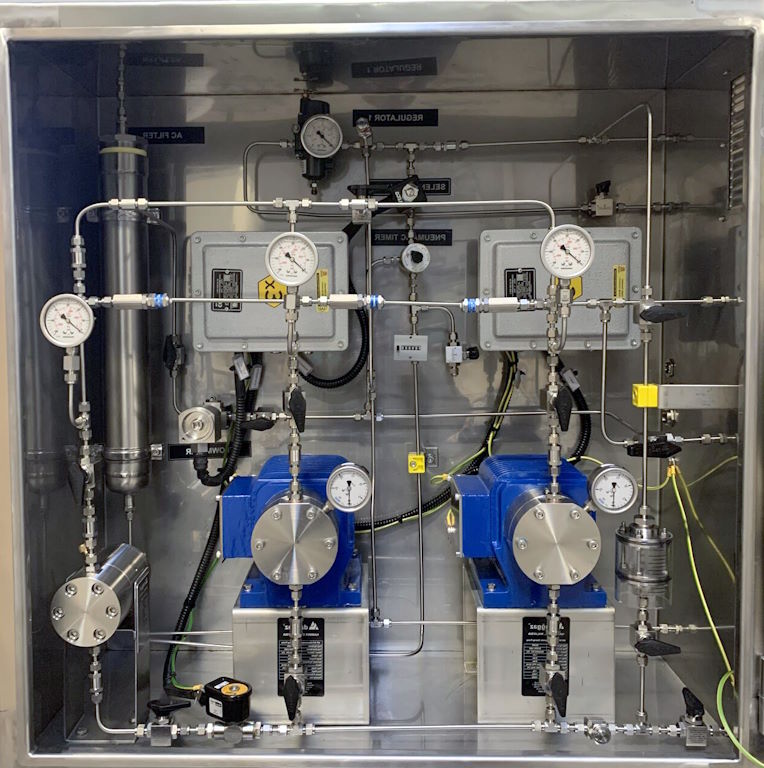
Hammerman Underwater Chemical Storage and Injection Facility
Stages of acid washing of the base material
-
The exploration and evaluation of deposits is carried out
by examining the type of rock, the deposit fluids, the temperature, the pressure and the type of damage. -
Development of acid treatment processes,
including the selection of acid type, concentration, injection volume and pump speed. -
Well preparation,
initial cleaning, pressure testing and checking the operational readiness of the equipment . -
Pre-rinsing during injection molding serves
to prepare the mold. -
The main acid solution is injected at a pressure below the fracking pressure . -
Excessive acid intake allows
the acid to penetrate deeper, ensuring thorough cleaning of the oil. -
Resumption of production and evaluation of the results.
Advantages of matrix etching
-
More cost-effective than intensive stimulation methods
-
The layers show no artificial cracks.
-
Suitable for old and unproductive wells.
-
After the operation, production volumes increased dramatically.
-
Repeat as needed.
Limitations and problems
-
Reduced efficiency in highly heterogeneous layers.
-
Risk of device corrosion
-
Careful planning is required to avoid consequential damage.
-
It is extremely sensitive to the temperature and chemical composition of the storage tank.
The difference between mold etching and tank etching.
| Special feature | Washing the base material with acid. | acid-etched groove |
|---|---|---|
| Injection pressure | Less than the explosion pressure. | The compression is higher than in the case of failure. |
| Create a gap | NO | Yes |
| Main applications | Repair damage and improve permeability. | Increase the contact area with the storage tank. |
| It’s worth it | fewer | additionally |
The role of acid matrix washing in increasing productivity
Field studies have shown that acid leaching of the rock matrix can increase production in many oil wells by 20–300%. The exact increase depends on the type of rock formation, the extent of the damage, and optimal well design. For wells where damage to the well periphery is the primary cause of production losses, this method is considered one of the most cost-effective options.
Environmental and safety aspects
Handling acids always poses environmental and safety risks. Therefore, compliance with health, safety, and environmental regulations, the use of corrosion inhibitors, proper waste disposal, and staff training are essential for the successful and safe execution of pickling processes.
The future of matrix processing
Thanks to technological advances, the use of smart acids and nanoacids, and more precise reservoir modeling, the effectiveness of matrix acid purification has increased significantly. These advances ensure that this method remains an important tool for increasing petroleum recovery.
ABB’s advanced intelligent chemotherapy injection app
In conclusion
Acid remineralization (ARR) is one of the most important and widely used methods for increasing oil and gas production (EOR). Its purpose is to repair well damage and improve reservoir permeability. Successful ARR requires careful planning, the selection of appropriate acid solutions, and meticulous execution. Due to its favorable costs and high efficiency, ARR continues to play a crucial role in projects aimed at increasing oil and gas production and optimizing operations.