Stainless steel is widely used in various industries. Depending on its crystal structure and chemical composition, it is divided into three groups: ferrite, austenite, and martensite .
Martensitic steel is one of the most important stainless steel grades due to its high hardness, durability, and relative corrosion resistance under certain conditions . This steel is widely used in the tool, automotive, medical, and energy industries.
In this article, we will take a detailed look at the structure, properties, heat treatment, and applications of martensitic steel.
What is Maragini steel?
Martensitic steel is a type of stainless steel with a microstructure called martensite . Martensite is a body-centered tetrahedral (BCT) phase formed by rapid cooling of austenite.
Compared to ferritic and austenitic steels, martensitic steel has very high hardness and excellent tensile strength , but has lower ductility and toughness.
Chemical composition of martensitic steel
The chemical composition of martensitic steel is carefully balanced to ensure the stability of the martensitic phase after quenching. The key components include:
-
Carbon (C): 0.1% to 1.2%, is the main factor for hardness and the formation of martensite.
-
Chromium (Cr): 12% to 18% for corrosion resistance and surface hardness.
-
Nickel (Ni): Very small amounts, usually less than 1%, are used to control austenite.
-
Molybdenum and silicon: are sometimes added to improve corrosion resistance and surface hardness.
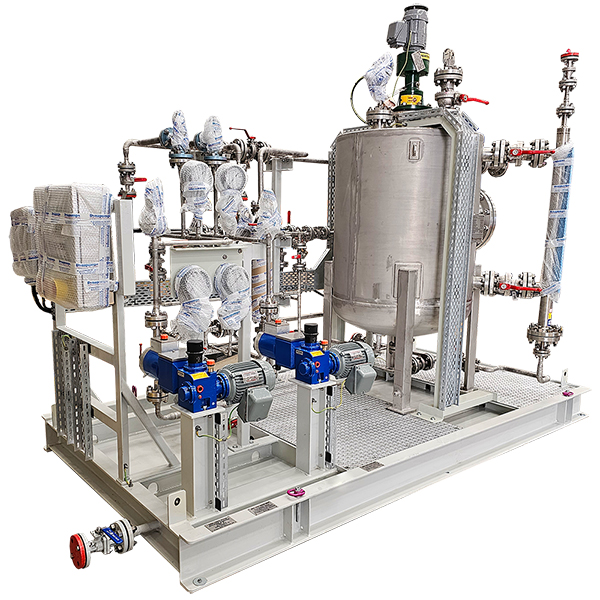
ICR application example: Chemical injection solutions, potassium formate-based system
Crystal structure and microstructure
-
Martensite (BCT): hard, brittle and compressive.
-
Retained austenite: Some steels may contain a small amount of retained austenite, which may slightly improve formability.
-
Carbides (cementite): In high-carbon steel, cementite particles increase hardness and wear resistance.
Mechanical properties of Maragini steel
1. Hardness and durability
-
The hardness of steel is very high and the hardness of steel used in tools is between 650 and 700 HV.
-
It has high tensile strength, typically 700 to 1300 MPa.
2. Hardness and flexibility
-
The hardness is lower than that of austenitic and duplex steels.
-
Limited ductility, especially at high carbon content.
3. Corrosion resistance
-
Corrosion resistance is medium to good depending on the chromium content and alloying elements.
-
The resistance to chloride corrosion is lower than that of austenitic and duplex steels .
4. Corrosion resistance
-
Very high abrasion and scratch resistance.
-
Suitable for blades, tools and industrial parts exposed to pressure and friction.
Heat treatment of martensitic steel
1. Cooling
-
After rolling or casting, the steel is heated to 900–1050 °C and then quickly cooled in water or oil.
-
This leads to the formation of a hard and brittle martensitic structure.
2. Moderate
-
Manganese steels tend to become brittle after quenching. Annealing is therefore necessary to increase their hardness and relieve stresses.
-
Annealing temperature and duration have a direct impact on hardness and toughness:
-
Low temperature → maintains hardness and slightly increases viscosity.
-
Higher temperature → lower hardness and higher viscosity.
-
Classification of maraging steel
-
Low carbon martensitic steel:
-
High carbon martensitic steel:
-
Extremely high hardness and excellent corrosion resistance.
-
For tools , blades and pulleys.
-
-
Martensitic steel alloys:
-
It contains elements such as chromium and molybdenum.
-
Better corrosion resistance and higher strength.
-
Application of maraging steel
1. Tool industry
-
Blades, scissors, knives and saws.
-
Cutting and forming tools.
2. Oil and gas industry
-
Valves, fittings and assemblies for medium and high pressure.
-
Relatively corrosion-resistant equipment in controlled environments.
3. Medical industry
-
Surgical instruments and dental devices with increased rigidity.
4. Automotive and aviation industries
-
Springs and drive shafts that require high mechanical strength.
5. Energy and mechanical engineering industries
-
Impellers, gears, turbine blades and wear parts.
Advantages of Maragini steel
-
Very high hardness and mechanical resistance.
-
The properties can be controlled by heat treatment.
-
Suitable for precision instruments and industrial parts.
Limitations and disadvantages
-
Low hardness, especially with high carbon content.
-
Limited resistance to chloride corrosion.
-
To avoid brittleness, careful heat treatment is required.
-
More difficult to machine than austenitic and ferritic steels.
Difference between martensitic, austenitic and ferritic steel
| Special feature | Martensitic steel | austenitic steel | ferritic steel |
|---|---|---|---|
| Crystal structure | Basic Military Training (BCT) | Federal Communications Commission | See Co |
| difficulty | very large | half | fewer |
| persistence | fewer | Great | half |
| Corrosion resistance | half | Great | Yes |
| Care | difficult | Easier | base |
| Inquiry | Tools and blades | Food and chemical industry | Designs and devices |
Finally
Martensitic BCT steel is a stainless steel grade characterized by very high hardness and mechanical strength . This steel is widely used in industries such as toolmaking, the oil and gas industry, the automotive industry, medicine, and energy technology.
Although the hardness is lower and the resistance to chloride corrosion is limited, a good balance between hardness and strength can be achieved through careful heat treatment .
In short, martensitic steels are ideal for applications that require high strength, corrosion resistance and hardness, as well as low to moderate corrosion resistance.