Welded joints play an important role in various industries in construction and manufacturing. They add strength and integrity to structures by creating a permanent bond between metal parts. The choice of the appropriate welded joint depends on various factors, such as load type, material, environmental conditions and economic considerations. This article will take a detailed look at the types of welded joints, their properties, advantages and disadvantages, and their industrial applications.
Basic classification of welded joints
1. Butt connection
Properties:
-
Connect two parts on the surface
-
Suitable for absorbing axial loads.
-
The edges must be prepared.
Types of background designs:
-
Welding with right-angled edge preparation : for thin thicknesses (up to 6 mm)
-
V-groove welding : for medium thickness (6–25 mm)
-
U-groove welding : for large thicknesses (over 25 mm)
-
J-Groove Welding : Saving Electrode Consumption
Uses:
-
Rohre
-
Pressure vessel construction
-
Metal structures for buildings
2. Corner connection
Properties:
-
Connect the two parts at a 90-degree angle.
-
Creation of monetary structures
-
Can be operated in open or closed position
Types of corner structures:
-
Corner weld with flange: high strength
-
Normal fillet welding : the simplest type
-
Welding of slit strips : for large thicknesses
Uses:
-
Window and door frames
-
Mechanical engineering
-
Body
3. Protective Connector (T-Connector)
Properties:
-
Vertical connection of two T-shaped parts
-
Bending Load Capacity
-
Need for Double-Sided Corner Welding for Heavy Loads
Types of shield constructions:
-
Single-sided corner weld : for light loads
-
Double-sided corner weld : for heavy loads
-
Semi-concealed groove welding : high strength
Uses:
-
Connecting beams to columns
-
Manufacturing of the machine base
-
Marine structures
4. Locking connection
Properties:
-
put two pieces together
-
Easy implementation
-
The corners must be welded
Types of lip overlap structures:
-
Single-sided corner welding : for thin sheets
-
Double-sided corner welding : for large thicknesses
-
Bridge groove welding : A combination of groove welding and slot welding.
Uses:
-
Creation of storage tanks
-
Thin board gluing
-
Aerospace industry
5. Edge union
Properties:
-
Connecting parallel edges of two parts
-
Suitable for thin sheets.
-
relatively low resistance
Types of page structures:
-
Square groove welding : The simplest way
-
V-groove welding : for large thicknesses
-
U-groove welding : for very large thicknesses
Uses:
-
Production of metal containers
-
Car bodies
-
Food industry
 Factors influencing the choice of welded joint type
1. Design Considerations
-
Type and quantity of imported goods
-
Charging direction
-
Space restrictions
2. Main considerations
-
Base Metal Type
-
Thickness
-
Mechanical properties of materials
3. Economic considerations
-
Costs of edge processing
-
Electrode Consumption
-
Delivery period
4. Implementation Issues
-
Access to the welding area
-
Available equipment
-
Welding skills
Welding processes for all types of joints
1. Manual Metal Arc Welding (SMAW)
-
Suitable for all types of connections.
-
High qualification required
-
Flexibility in different situations
2. MIG/MAG welding (GMAW)
-
high speed
-
Suitable for back and corner connections.
-
Need for modern equipment
3. TIG welding (GTAW)
-
High-quality welding
-
Suitable for confidential communication.
-
low speed
4. Submerged arc welding (UP)
-
Suitable for long connections.
-
High performance
-
Restricted by bed position
Quality control of welded joints
1. Visual inspection (IV)
-
Check the appearance of the weld.
-
Surface crack detection
-
Evaluation of weld uniformity
2. Non-Destructive Testing (NDT)
-
Penetration Testing (PT) : Surface Crack Detection
-
Magnetic Particle Testing (MPT) : for ferromagnetic materials
-
Ultrasonic Testing (UT) : Detection of internal defects
-
Radiography (RT) : Images of defects
3. Destructive Testing
-
Tensile test
-
Flexion test
-
Impact test
Acceptance criteria for welded joints
1. Size standards
-
Weld size
-
Convexity or concavity of a weld
-
Welding standardization
2. Quality standards
-
No cracks
-
No gas inclusions
-
Without impurities
3. Resistance criteria
-
Tensile strength
-
Bending force
-
Persistence
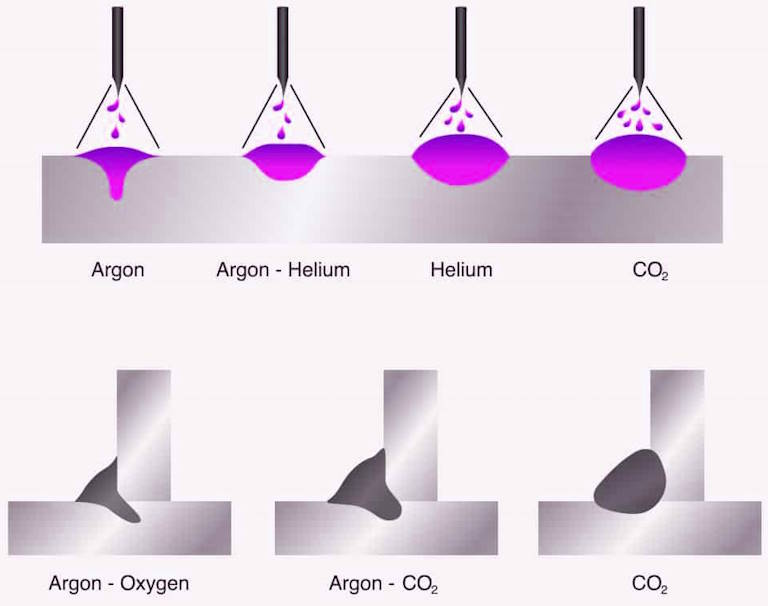
Common problems with welded joints and their solutions
1. Cracks in the weld seam
Reasons:
-
Thermal stress
-
Insufficient chemical composition
-
Rapid cooling
Solutions:
-
Preheat
-
Control of the chemical composition of the electrode
-
Controlled cooling
2. Porosity during welding
Reasons:
-
Surface contamination
-
Not enough shielding gases
-
Moisture on the electrode
Solutions:
-
Deep cleaning of surfaces
-
Use a suitable shielding gas.
-
Proper Electrode Maintenance
3. Thermal deformation
Reasons:
-
Uneven heat distribution
-
Shrinkage during cooling
-
Incorrect installation of parts
Solutions:
-
Correct welding sequence
-
Use appropriate clamps
-
Symmetrical welding
Standards for welded joints
1. AWS D1.1-Standard
-
Standard for welding steel structures
-
Communication Design Requirements
-
Eligibility criteria
2. ASME Standard, Section 9
-
Requirements for Pressure Vessel Welding
-
Qualification of welding processes
-
Non-destructive testing
3. ISO 2553-Norm
-
Welding symbols on drawings
-
Contact brand
-
Required technical information
Innovations in welding technology
1. Friction stir welding (FSW)
-
The base material does not dissolve.
-
Suitable for aluminum alloys.
-
Reduce thermal distortion
2. Laser welding
-
Very high resolution
-
deep penetration
-
Minimal heat-affected zone
3. Electron beam welding
-
Suitable for heat-sensitive materials.
-
Excellent quality
-
The need for a vacuum environment
Graduation
Choosing the right weld has a direct impact on the quality, durability and strength of the finished structure. Understanding the properties, pros, and cons of each type of connection helps engineers and welders make the optimal decision for the specific project conditions. With the advancement of welding technology, new processes for joining different materials have been developed, enabling the production of complex, high-performance structures. Compliance with welding standards and strict quality controls ensure the reliable function of the welded joints over their entire service life .
Frequently Asked Questions
1. Which type of welded joint is best suited for high loads?
When installed correctly, penetrating joints provide maximum strength under high loads.
2. What is the main difference between a panel joint and a corner joint?
In a panel connection , one part is positioned perpendicular to the center of another part (T-shape), while in a corner connection, two parts are joined together at the corner (L-shape).
3. Is it possible to change welded joints afterwards?
Yes, some defects can be corrected by methods such as grinding and re-welding, but this work must be carried out by professionals and in accordance with the regulations.
4. What type of welded joint uses the fewest electrodes?
When welding with overlapping seams on one side , electrode consumption is usually the lowest , but their strength is also lower than with other types.
5. How can deformation of welded joints be avoided?
Deformation can be reduced by the correct welding sequence, preheating, mechanical adjustment of the parts and control of the heat supply.